Staying competitive in today’s business environment is not easy. Simply having an online store or a service website does not mean customers and sales will follow automatically.
To generate consistent traffic, enquiries, and sales, a website needs a well-planned advertising strategy. One of the strategies that can help is remarketing (retargeting), which allows you to reconnect with users who have already shown interest in your products or services but have not yet made a purchase.
In this article, we explain what is remarketing, how it works, and why it remains one of the most powerful advertising tools in modern digital marketing.
Table of Contents
What Is Remarketing And Why Is Remarketing Important?
In an ideal scenario, you create compelling ads, understand your audience’s priorities, and visitors go on to make a purchase.
In reality, things are rarely that straightforward.
- Research shows that potential online shoppers often add products to their virtual shopping cart but never actually buy them.
- According to statistics, more than 2/3, or 66.5%, of users who add products to their cart don’t complete the purchase.
- As many as 90% of users who visit a website take no action at all, such as completing a conversion.
There can be many reasons for this. A shopper may simply not be ready to buy yet, may still be comparing options, or may be waiting for a sale or another offer that feels more relevant.
This is where remarketing (retargeting) and the strategies behind it become useful for advertisers.
What Are the Benefits of Remarketing?
Remarketing is an exceptionally effective digital marketing strategy. Research also shows that remarketing campaigns can increase click-through rates by 161% compared with regular display advertising.
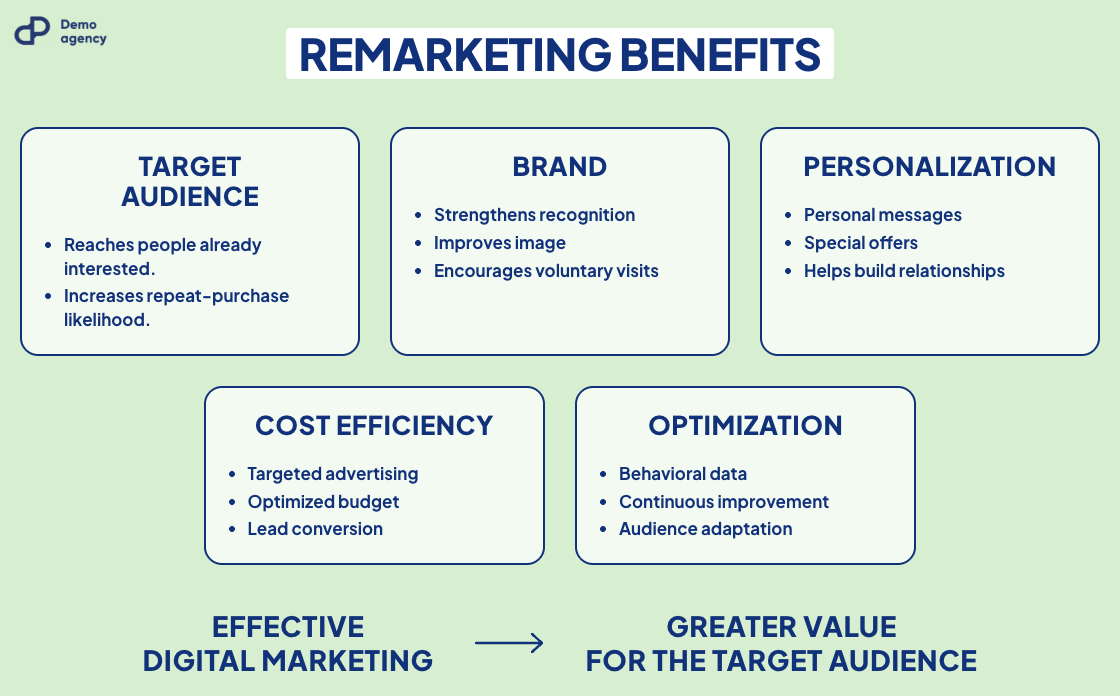
As a way of re-engaging potential customers, remarketing is effective because it:
- Lets you reach your target audience. Someone who has already visited your website at least once may be more likely to buy a product or service when they return. Remarketing strategies give you another opportunity to reach that person.
- Increases brand awareness. Seeing a brand’s ads more than once can help shoppers remember the brand, the value it offers, and its overall image. As familiarity grows, so does the likelihood that the shopper will return to the website on their own later.
- Lets you create personalized messages. You can speak to your audience more directly, remind them about actions they started and, where relevant, offer a shopping discount. This type of communication often feels more personal and can help build a stronger connection.
- Is cost-effective. Ads are shown to people who have already expressed an interest in your products or services. That allows you to focus your advertising budget on users who are more likely to move from potential customers to loyal ones.
- Offers even more optimization opportunities. Remarketing provides detailed information about user behavior and interests, making it easier to refine campaigns around the parameters that matter most to the audience.
Investing in remarketing campaigns can be worthwhile because they provide a much more personalized way to present offers and create value for your target audience.
In remarketing campaigns, everyone usually wins: advertisers, brand owners, and shoppers.
Advertisers reach the audience they want, shoppers receive information that is more relevant and appealing to them, and brand owners gain more attention while improving their overall image and visibility online.
Remarketing: The Process of Winning Back Potential Customers. How Is It Done?
The term remarketing itself already hints at the basic idea: certain advertising actions are carried out again, and the user is encouraged to complete a specific action they did not take during their first visit to the website.
For example, they may be encouraged to:
- fill out a questionnaire;
- subscribe to a newsletter;
- download an e-book;
- buy a product that is, for example, in limited supply;
- purchase a service;
- use a discount, etc.
Key Aspects of Remarketing
When running a remarketing campaign, it is particularly important to:
- choose well-targeted photos, images and other visual content that reflect customers’ needs;
- create useful, persuasive copy;
- invite the customer to take a specific action through a call to action (CTA), while giving them a clear reason or offer to do so.
Each of these elements can influence the user’s decision to buy. The aim is to encourage them to return and complete the purchase journey they previously left unfinished.
A Practical Remarketing Example
A person is currently looking for jeans. They visit an online store that is running a sale with 30% off all products.
They find several pairs they like but hesitate. Maybe it would be better to wait until payday? They add one pair to the cart but eventually close the online store without completing the purchase.
That does not necessarily mean the opportunity is lost. The online store invests in remarketing campaigns, so the following day the same person sees an ad from the store in their Facebook feed featuring a selection of stylish jeans.
The ad catches their attention because an additional 10% discount is available for today only. They return to the same online store and buy the jeans.
The remarketing strategy used in this example is based on reminding the user that they left an action unfinished.
The goal is to bring the user back and encourage them to finally purchase a product they were actively interested in earlier, whether that was a day ago or a few days before.
5 Key Steps of Remarketing: What Are They?
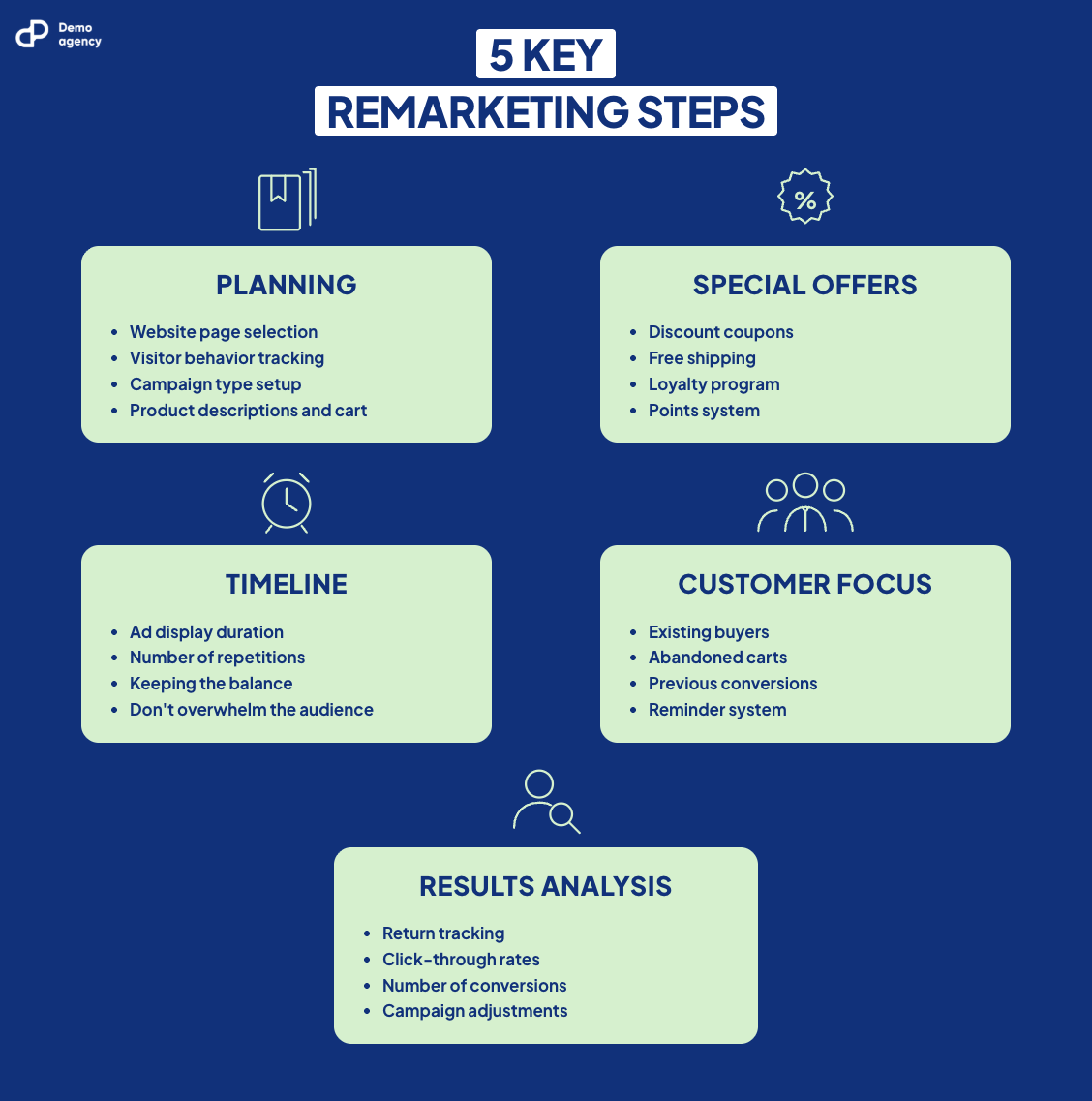
- Planning. A good place to start is deciding which pages of your website you want to track visitor activity on. Once you know which part of the visitor’s journey you want to focus on, you can begin planning the appropriate campaign types. For example, if you track product description pages and the shopping cart, you can use the information collected there to create ads featuring the specific products the user previously showed an interest in.
- Special offers. Shoppers you want to bring back to the website can be offered a discount coupon of a certain value or free delivery. A loyalty program can also be useful. For example, customers could use accumulated points to cover part of a future purchase. This gives them another reason to return and can help turn them into regular customers.
- Timeline. Once you have decided what type of campaign to use, the next step is determining how long it should run and how often the ads should be shown to the target audience. This matters because showing the same ads too frequently or for too long can tire the audience and have the opposite effect, making people less interested rather than more.
- Attention to customers who have already taken certain actions. Remarketing campaigns do not have to focus only on shoppers who added products to their cart and disappeared. They can also target people who have previously converted or purchased products from your website. The goal is to encourage them to return and become regular customers. For example, a popular pool and spa in Lithuania tracks when customers last visited and sends newsletters with the subject line: “We haven’t seen you in almost a year… Time to meet again!”
- Reviewing and analyzing results. Once a remarketing campaign has run, the final step is to review the data and assess how effective it was. You can look at how many users returned to the website, as well as click-through rates, conversion rates, and other relevant indicators. These insights can then be used to improve future campaigns.
How Is User Data Collected? Is It Legal?
Remarketing works by bringing users back into the buying process, and traditionally one of the main tools used to track website visitors has been cookies.
However, the use of cookies is restricted by various data protection regulations. As a result, websites also use more advanced tracking technologies.
These technologies can recognize users through different signals, for example:
- the device used for browsing;
- the user’s IP address, if it is not hidden;
- behavior, such as which products or services are viewed and how much time is spent on particular pages, etc.
All of this can be done without relying on cookies. This makes it possible to use effective remarketing tools without depending on customers’ private data.
Of course, if a user accepts the cookie policy, collecting relevant data becomes easier.
How to Make Full Use of Remarketing Opportunities?
If you do not yet have much experience with remarketing, trying to manage everything yourself can take a significant amount of time without necessarily delivering meaningful results.
For that reason, it can be worth consulting specialists and, when aiming for the best possible results, entrusting the entire remarketing process to them.
With years of experience, a close eye on advertising trends, and more than €5 million in revenue already generated for clients, Demoagency understands what effective, conversion-focused advertising requires today.
For businesses looking for a smooth and effective advertising process, we offer:
- Google Ads advertising strategy, creation, and smooth implementation based on your current goals (KPIs).
- Facebook advertising strategy, creation, and smooth implementation to achieve your set goals.
We invest significant time and expertise in developing and implementing effective advertising strategies. We analyze the available data and continuously optimize advertising based on the client’s needs, audience behavior, and opportunities that have not yet been fully used.
The main goal of our remarketing campaigns is to bring undecided shoppers back and generate measurable, profitable value for your business.